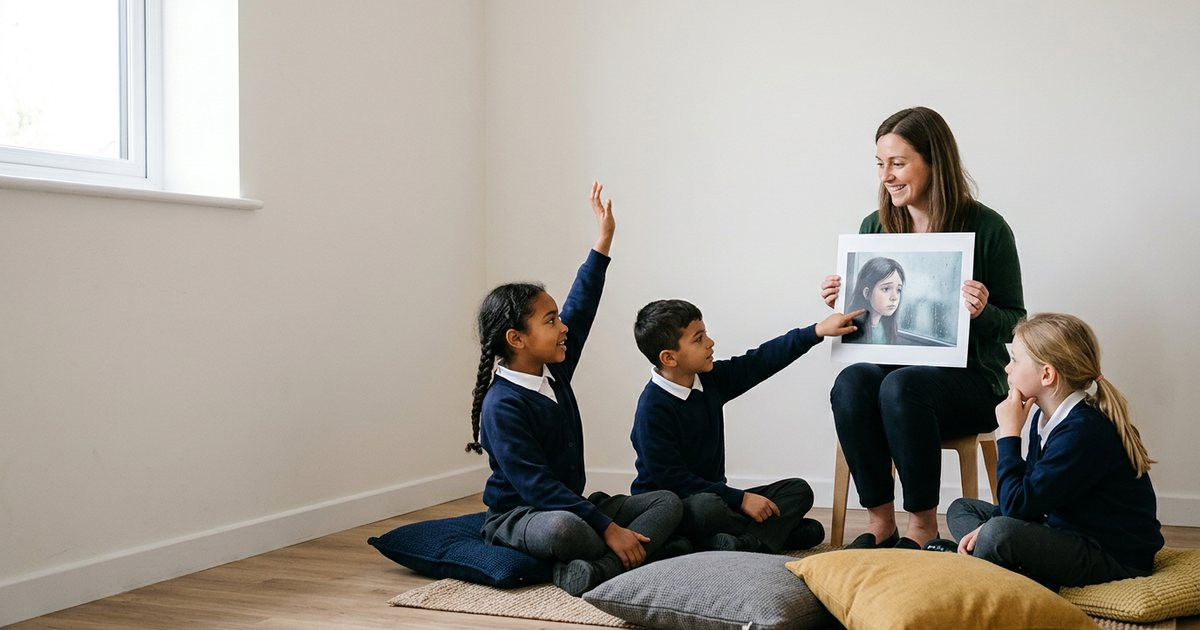
If your child comes home talking about "VIPERS", they are not studying snakes. VIPERS is a way many primary schools organise reading comprehension, using one letter for each of six skills: Vocabulary, Infer, Predict, Explain, Retrieve, and either Sequence or Summarise. It was created by Rob Smith of The Literacy Shed, and it is built around the reading skills assessed in the national tests.
Knowing what each letter means makes it much easier to talk about books at home in a way that matches what happens in class.
|
Letter |
Skill |
What your child is learning to do |
|---|---|---|
|
V |
Vocabulary |
Work out and explain what words and phrases mean in context |
|
I |
Infer |
Read between the lines, using clues to work out feelings, motives and meaning |
|
P |
Predict |
Suggest what might happen next, based on evidence in the text |
|
E |
Explain |
Say how the writer's choices of words, structure and ideas create an effect, and give their own views |
|
R |
Retrieve |
Find and record key details from the text |
|
S |
Sequence (KS1) or Summarise (KS2) |
Put events in order, or sum up the main ideas of a passage |
The only difference between Key Stage 1 and Key Stage 2 is the final S. Younger children learn to sequence events. Older children learn to summarise ideas across several paragraphs, which is harder because it means deciding what matters most.
The Key Stage 2 reading test is built from eight "content domains" set out in the official reading test framework. VIPERS groups them into something children can remember:
Vocabulary covers domain 2a, the meaning of words in context.
Retrieve covers 2b, finding key details.
Summarise covers 2c, summing up main ideas.
Infer covers 2d, making and justifying inferences.
Predict covers 2e, predicting from details stated and implied.
Explain covers 2f, 2g and 2h: how content contributes to meaning, how word choices enhance meaning, and comparisons within a text.
The test framework allows the most marks for retrieval and inference, each worth between 8 and 25 of the 50 marks. Vocabulary questions account for 5 to 10 marks. Prediction and the explain domains carry fewer marks each, but they still appear.
Here is how each skill might sound when you are reading a story together.
Vocabulary
What does the word "gloomy" tell us about the house?
Find a word that shows the dog was frightened.
Infer
Why do you think Sam didn't answer his mum?
How do you know the teacher was cross, even though it doesn't say so?
Predict
What do you think will be inside the box? What makes you think that?
Now that the storm has started, what might happen to the boat?
Explain
Why did the author make this sentence so short?
Did you like how the chapter ended? Why?
Retrieve
What time did the train leave?
Where did they hide the key?
Sequence (Key Stage 1)
What happened after they found the map?
Can you put these three events in order?
Summarise (Key Stage 2)
What is this chapter mainly about, in one sentence?
Which paragraph is the most important? Why?
You do not need to work through all six skills every time. One or two questions after a chapter is plenty.
It helps to vary the skills over a week, because children often find some much easier than others. Many children are confident with retrieval, finding a fact in the text, but find inference and summarising harder. If you notice your child always answering "I don't know" to "why" questions, spend a little more time on inference and explaining, and model your own thinking: "I think he's worried, because he keeps checking his watch."
Encourage your child to find evidence. "Show me where it says that" turns a guess into a supported answer, which is exactly what earns marks in Year 6.
Non-fiction works too. Retrieval and summarising are especially natural with information books, news articles and recipes.
It is common for a child to read fluently and still struggle with one or two VIPERS skills. Our KS2 English tuition practises each skill through discussion and guided reading, and a free assessment can show which areas need the most attention.
No. VIPERS is a teaching approach that many schools use. The skills it covers come from the national curriculum and the KS2 reading test framework.
Retrieval and inference carry the most marks in the KS2 reading test. Vocabulary questions also appear in most papers.
Recent Posts
Categories
Tags




 Updated 23-November-2026