Updated 18-November-2026
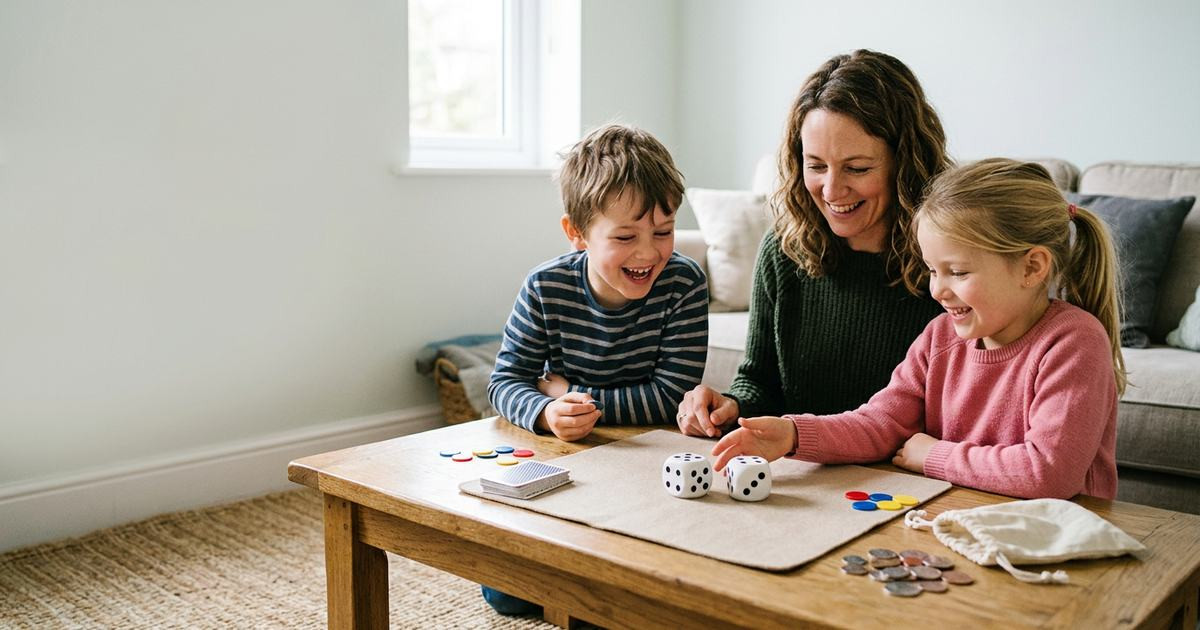
A pack of cards and two dice can do more for a child's number skills than a stack of worksheets. Short games get children recalling number facts quickly, again and again, without it feeling like homework. They also give you a relaxed way to spot what your child finds easy and where they hesitate.
Each game below takes five to fifteen minutes, needs very little equipment, and links to what children learn at school. They are grouped by age, but most can be made easier or harder in seconds.
You need: a pack of cards with the picture cards removed.
Deal the cards between two players. Take turns placing a card face up. If the top two cards add up to ten, the first to shout "ten" wins the pile. Number bonds to ten underpin almost all later addition and subtraction.
Make it easier: play "snap to five" with cards up to five only.
You need: one dice, a counter each and a simple track of 20 squares drawn on paper.
Roll and move. Before moving, your child says where they will land. "I'm on 7 and I rolled 4, so I'll be on 11." It builds counting on, which children often find harder than counting from one.
You need: a cloth bag and up to ten small objects.
Put some objects in the bag while your child watches, then take some out. How many are left? It is subtraction in its most concrete form.
You need: digit cards from 0 to 9, or playing cards from ace (as 1) to 9.
Each player draws two cards and arranges them to make the largest two-digit number they can. Biggest number wins. Then try making the smallest. Your child is reasoning about tens and ones without realising it.
You need: one dice.
Roll and double the number. Then try two dice added together and doubled. Quick recall of doubles helps with later multiplication and mental addition.
You need: paper and a pencil.
Each player writes six numbers from the 2, 5 or 10 times table on a grid. Call out questions like "3 times 5". If the answer is on your grid, cross it off. First to cross everything off wins.
You need: a pack of cards with picture cards removed.
Each player turns over two cards and multiplies them. The higher answer wins all four cards. Start with only the cards for the tables your child is learning, then add more. In Year 4 children sit the national multiplication tables check, so quick recall of facts up to 12 times 12 matters.
You need: one dice.
Take turns rolling and deciding whether to add the number as ones or as tens. The aim is to get as close to 100 as possible in six rolls without going over. It mixes place value, mental addition and a little strategy.
You need: coins and a few items with price labels.
One person runs the shop. The other pays with a coin or note larger than the price and checks their change by counting up. Handling money is mental arithmetic with a real purpose.
You need: cards you write yourself showing fractions, decimals and percentages such as 1/2, 0.5, 50%, 1/4, 0.25 and 25%.
Turn them face down and play pairs. A match is any two cards with the same value. By Year 6, children are expected to recall these equivalences quickly.
You need: six number cards and a target number.
Pick some small numbers and one or two large numbers such as 25, 50 or 75. Choose a target between 100 and 500 and try to reach it using some or all of the numbers with any of the four operations. It is excellent practice in mental calculation and in choosing an efficient method.
You need: a real shopping trip or an online basket.
Round each price to the nearest pound and keep a running total. Compare your estimate with the real total at the till.
A few habits make the difference between a game that helps and one that frustrates. Keep sessions short and stop while your child still wants to play. Let them win sometimes, but not always. Talk about strategy: "Why did you choose to put the 6 in the tens?" And if your child keeps hesitating on the same facts, make a note and focus the next game on those.
Games work best alongside what your child is learning at school. The national curriculum for maths sets out what is expected in each year, which can help you pick the right game.
Sometimes a game shows that a skill is shakier than expected. Counting on fingers for every number bond in Year 2, or not knowing which of two numbers is bigger, are signs that the foundations need attention. Our KS1 maths tuition and KS2 maths tuition work on exactly those foundations.
Recent Posts
Categories
Tags