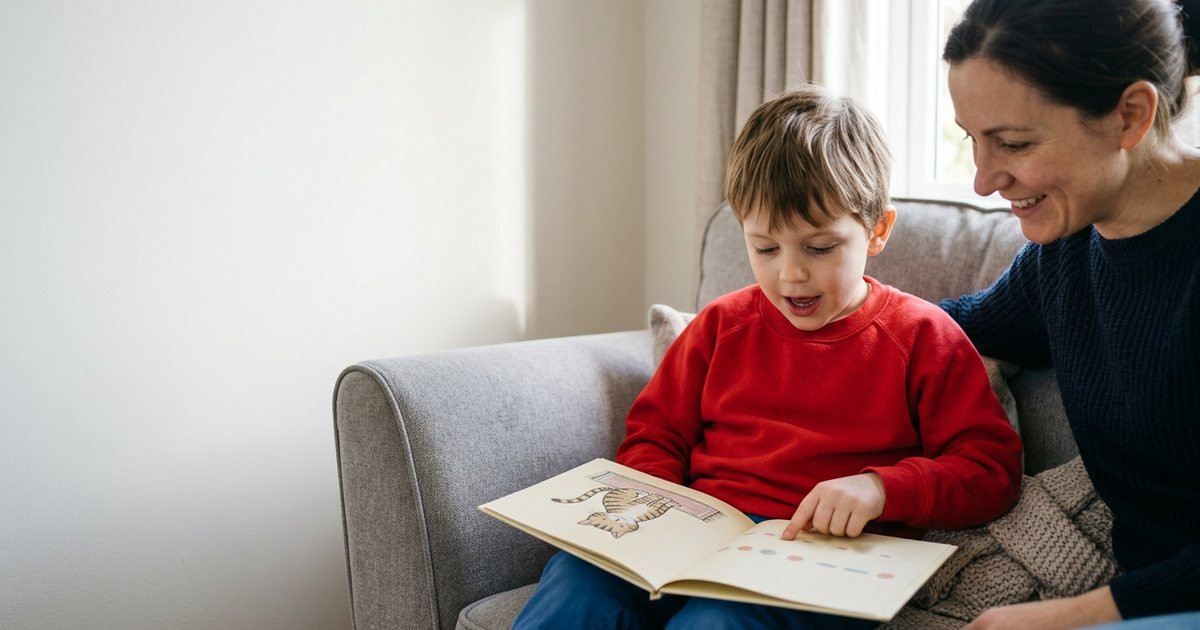
The questions you ask while reading together can do as much for your child's understanding as the reading itself. A good question makes a child look back at the text, think about why something happened, or notice how the writer made them feel. These are the same skills tested in the Key Stage 2 reading paper, and they grow naturally from conversations at bedtime.
Below are questions grouped by stage, from picture books to Year 6 novels. You do not need to ask many. Two or three good questions per session are plenty, and the reading should always stay enjoyable.
Looking at the cover and title first gets your child thinking about what is to come.
What do you think this book might be about?
Have you read anything else by this author? What was it like?
Look at the cover. Where do you think the story is set?
For non-fiction: What do you already know about this topic? What would you like to find out?
At this stage, questions should be short, friendly and often linked to the pictures.
Finding information
Who is in the story?
Where are they?
What happened first? What happened next?
Thinking about characters
How do you think the bear is feeling now? How can you tell?
What would you have done if you were the little girl?
Predicting
What do you think will happen when he opens the door?
How do you think the story will end?
Words
What does "enormous" mean? Can you find another big word on this page?
Which word in this sentence did you like best?
Retelling
Can you tell me the story in your own words?
What was your favourite part, and why?
Children now read longer texts with less help from pictures. Questions can ask them to look back through the text and give reasons.
Can you find the sentence that tells us where they are?
Why do you think the character said that?
What does this word mean here? What clues in the sentence helped you?
How has the main character changed since the start of the book?
What do you think the author wants us to feel at this point?
Sum up what happened in this chapter in two or three sentences.
By the end of Key Stage 2, the reading paper asks children to infer, explain and compare. Questions for older readers can reflect that.
What does this tell us about the character, even though the writer does not say it directly?
Why do you think the author chose the word "crept" instead of "walked"?
How does this chapter build tension? Find two examples.
Compare how the two characters react to the same event.
Is the narrator someone you trust? Why or why not?
How is this book similar to another one you have read?
The Key Stage 2 reading test is built around a set of reading skills listed in the official test framework. Many schools teach these through the VIPERS approach.
|
Skill |
Example question |
|---|---|
|
Vocabulary: explain the meaning of words in context |
What does "reluctant" mean in this sentence? |
|
Retrieval: find key details |
When did the storm begin? |
|
Summarising: sum up main ideas |
What is this chapter mainly about? |
|
Inference: read between the lines |
Why do you think she hid the letter? |
|
Prediction: use clues to suggest what happens next |
What might happen when they reach the castle? |
|
Explaining: how word choice and structure create meaning |
Why did the author start with a question? |
|
Comparing within the text |
How is the town different at the end compared with the beginning? |
Ask "how do you know?" The most useful follow-up question of all. It sends your child back to the text for evidence, which is exactly what reading tests reward.
Let silence happen. Children often need a few seconds to think. Resist the urge to answer for them.
Share your own thoughts. "I think he's lying, because he looked away when he said it. What do you think?" Modelling your thinking shows your child how readers reason.
Do not turn it into a test. If your child is absorbed in the story, let them read. You can talk about it afterwards.
Mix it up. Some days, let your child ask you the questions.
Some children read words fluently but struggle to explain what they have read. Others answer retrieval questions easily but find inference hard. If you notice either pattern persisting over months, mention it to the class teacher. Our KS2 English tuition and, for younger children, KS1 English tuition work on these comprehension skills in a structured way.
Two or three well-chosen questions are usually enough. Too many can make reading feel like a test.
Ask them to look back at the text together. "Let's find the part where it tells us." The aim is to build the habit of checking, not to catch them out.
Recent Posts
Categories
Tags



 Updated 19-November-2026