A-Level Physics often feels difficult not because the ideas are impossible to understand, but because many students struggle to apply the right method under exam pressure. Motion questions, in particular, can feel confusing. Numbers look unfamiliar, situations appear different each time, and it is not always clear which equation to start with.
This guide explains the equations of motion in a clear, step-by-step way used by experienced tutors. By the end, A-Level students will know when these equations apply, how to choose the correct one with confidence, and how to avoid the common mistakes that cost valuable exam marks.
Most motion problems are not testing advanced mathematics. Instead, examiners want to see whether you can:
Identify what information is given
Recognise what needs to be found
Select an appropriate equation
Apply it accurately and logically
Students often lose marks not because they lack understanding, but because they choose the wrong equation or apply a correct equation in the wrong situation.
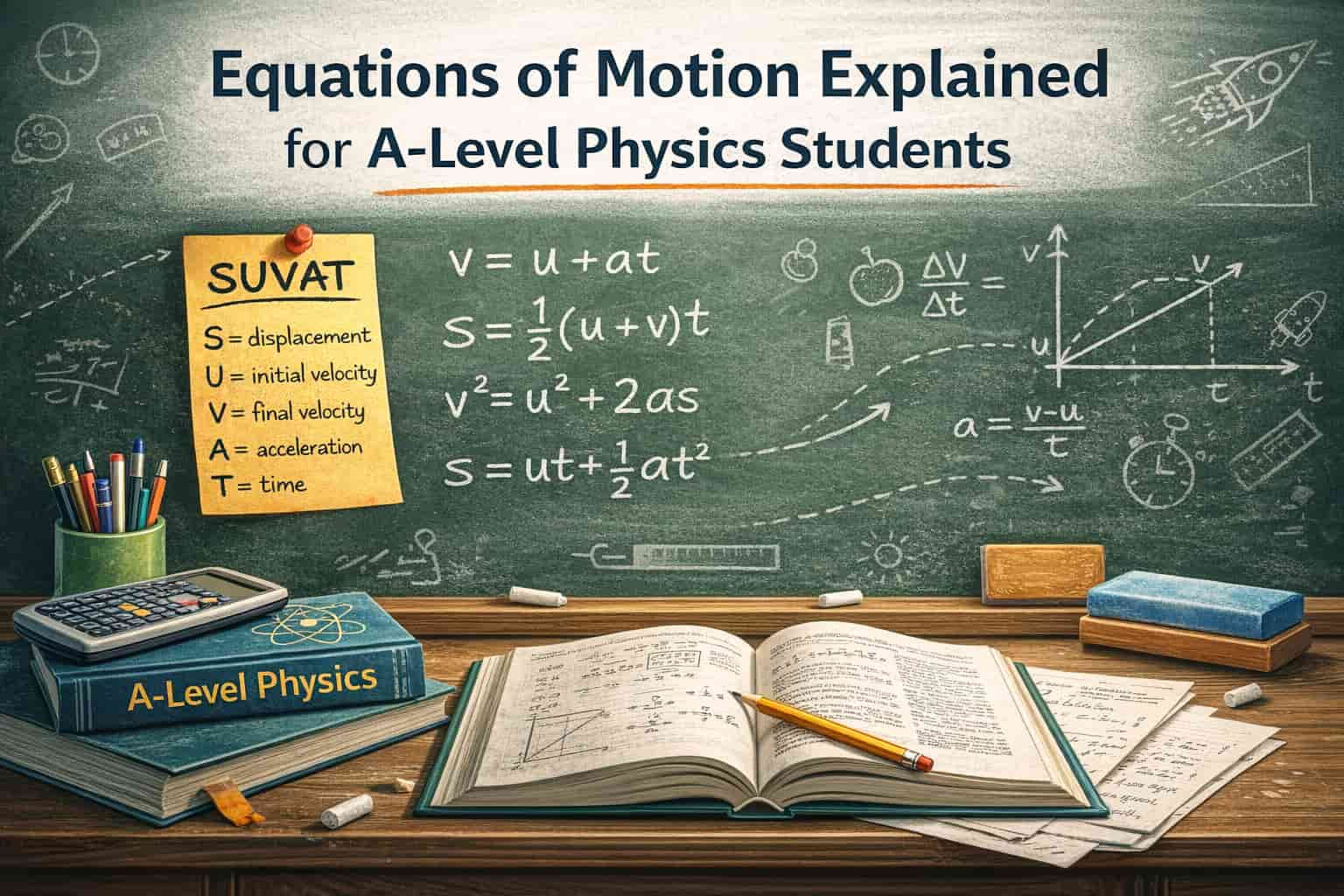
In A-Level Physics, equations of motion describe how objects move when they experience constant acceleration in a straight line. These equations link five key physical quantities:
Displacement
Initial velocity
Final velocity
Acceleration
Time
If you know any three of these quantities, you can usually calculate the remaining ones using a suitable equation.
Before applying any motion equation, it is essential to check whether the situation is appropriate. The equations of motion apply only when:
Acceleration is constant
Motion occurs in a straight line
Air resistance is negligible
If acceleration changes during the motion, or if the object follows a curved path, a different method must be used.
Many mistakes happen simply because students forget what each variable represents. Before substituting values into an equation, always confirm that:
Displacement is not the same as distance
Velocity includes direction
Acceleration may be negative (this indicates deceleration)
Time is measured in seconds
Spending a few seconds checking these details can prevent unnecessary errors.
A reliable method that works in almost every exam question is:
List all the quantities you are given
Identify the quantity you need to find
Choose an equation that includes the known values and excludes the one you do not need
This logical approach removes guesswork and helps you work confidently through the problem.
For students who want a deeper breakdown of how these equations work together, this SUVAT equations guide explains the full method with worked examples and exam-focused tips:
👉 https://meritstudyresources.co.uk/blogs/mastering-suvat-equations-your-complete-guide-to-a-level-physics-motion
This resource is especially useful when practising exam-style questions.

A car starts from rest and accelerates uniformly at 2 m/s² for 5 seconds.
Initial velocity = 0 m/s
Acceleration = 2 m/s²
Time = 5 s
Using the appropriate equation, students can calculate the final velocity step by step. Writing each step clearly is important, as examiners award method marks even if a small numerical error occurs later.
An object moves with an initial velocity of 4 m/s and accelerates at 1.5 m/s² for 6 seconds.
By identifying the known values first, students can select the correct equation and calculate the displacement accurately. This approach mirrors how A-Level exam questions are structured and helps avoid choosing the wrong equation.
A cyclist slows down uniformly before coming to a stop.
In this type of question, recognising that acceleration is negative is essential. Identifying deceleration early prevents sign errors, which are one of the most common causes of lost marks.
Even confident students lose marks due to small but avoidable errors. The most common mistakes include:
Direction matters. Always decide which direction is positive before starting the calculation.
Time must be in seconds, speed in metres per second, and acceleration in metres per second squared. Convert units before using any equation.
If acceleration changes during the motion, these equations are not valid. Always read the question carefully.
A train accelerates uniformly from rest for 10 seconds. Calculate its final velocity.
A ball is thrown vertically upwards with a known initial speed. Find the time taken to reach maximum height.
A car decelerates uniformly to a stop. Determine the stopping distance.
Attempt these questions under exam conditions to build confidence and accuracy.
At Merit Tutors, we regularly support students who understand the theory but struggle with application. Through guided practice, students learn to:
Recognise patterns in exam questions
Select equations confidently
Show clear working to gain full method marks
Build speed without sacrificing accuracy
This structured approach leads to measurable improvements in exam performance and confidence.
Understanding formulas is only the first step. Real improvement comes from applying them to exam-style questions, where students must decide:
Which information is relevant
Which equation fits the situation
How to present a clear, logical solution
Regular, targeted practice turns confusion into consistency.
Are equations of motion included in GCSE Physics?
Yes, simplified versions are introduced at GCSE level. At A-Level, questions are more complex and require multi-step problem solving.
Can equations of motion be used when acceleration is zero?
Yes. If acceleration is zero, the object is moving at constant velocity, and the equations still apply with acceleration set to zero.
How do I know which equation to use in an exam?
List the values you are given and the value you need to find, then choose the equation that includes those quantities.
Do examiners expect full working?
Yes. Clear working is essential for earning method marks, even if the final answer is incorrect.
Equations of motion are a core part of A-Level Physics, and mastering them can significantly improve exam results. By understanding when these equations apply, choosing the correct one logically, and avoiding common mistakes, students can approach motion questions with confidence.
With the right guidance and consistent practice, even challenging mechanics questions become manageable.
Recent Posts
Categories
Tags



 Updated 01-January-2026