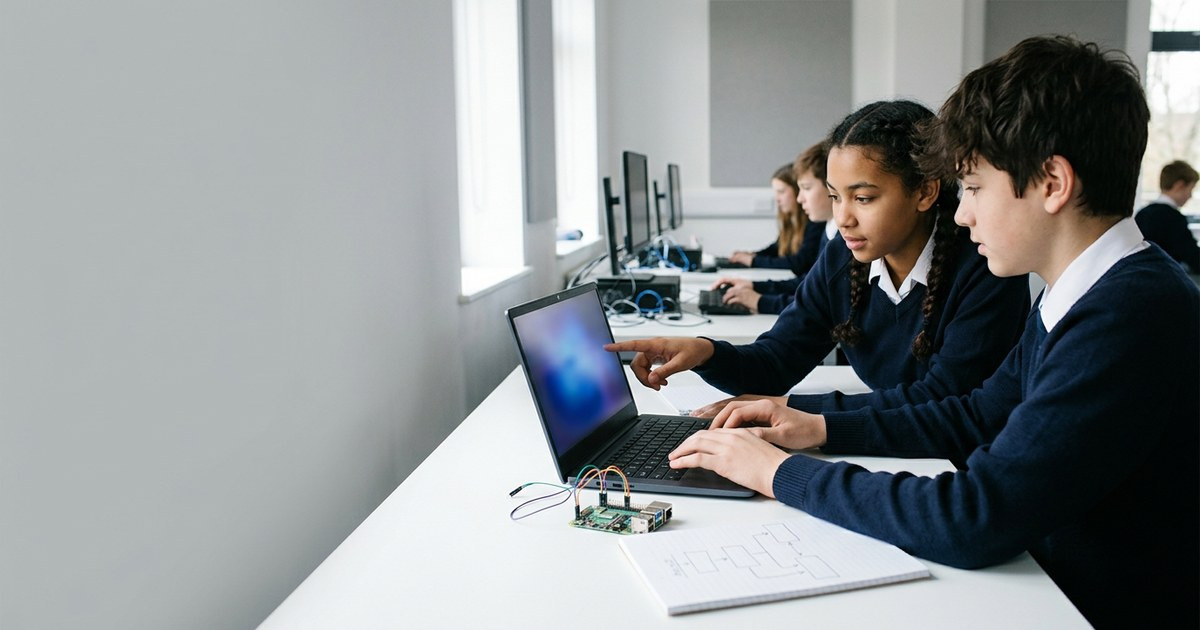
Students can use AI tools such as ChatGPT in some GCSE and A Level coursework, but only if their school allows it for that task and only if they acknowledge it in detail. Even then, anything the AI produced earns no marks. In exams, AI is not allowed at all. These are the rules set by the Joint Council for Qualifications (JCQ), the body that writes the exam regulations all the main boards follow. Breaking them can cost a student a component or, in serious cases, the whole qualification.
The JCQ guidance covers any assessment done partly outside the exam hall. That includes non-exam assessment (NEA) such as A Level English Literature, History or Geography coursework, practical projects in subjects like design and technology, and the Extended Project Qualification. In written exams, an AI tool is treated like any other unauthorised material.
The full guidance is in JCQ's document AI Use in Assessments: Your role in protecting the integrity of qualifications.
Everything submitted must show the student's own independent work and thinking. Before coursework is sent to the exam board, a teacher signs a declaration that it is authentic. If they cannot be confident of that, they must not accept it.
This is where many students misunderstand the rules. They assume that as long as they say they used AI, they are safe. Acknowledgement does protect them from a malpractice finding, but it does not earn credit. Assessors mark only what the student produced independently. A paragraph written by ChatGPT, however well acknowledged, is a paragraph that scores nothing.
Consider two A Level history students working on the same coursework question.
The first is stuck on the background to a period she has not studied in class. With her teacher's permission, she asks an AI tool to summarise the main events, checks every point against her textbook and two academic sources, and then writes her own analysis from those sources. She records the tool's name, the date, her prompt and the response, and explains briefly how she used it. Her coursework is entirely her own argument.
The second asks an AI tool to "write a 500-word evaluation of this interpretation", rewords the result so it sounds like him, and lists "ChatGPT" in his bibliography. That is misuse on several counts: the analysis is not his, paraphrasing AI output is explicitly covered, and a one-word reference is not an adequate acknowledgement.
|
Misuse |
What it looks like |
|---|---|
|
Copying AI output |
Pasting an AI paragraph into an essay |
|
Paraphrasing AI output |
Rewording an AI answer so it looks original |
|
Letting AI do the thinking |
Using AI for the analysis, evaluation or calculations the task assesses |
|
Hiding AI as a source |
Using facts from AI without saying so |
|
Inadequate acknowledgement |
Writing only "AI" or "ChatGPT" in a bibliography |
|
Misleading references |
Listing sources that do not exist or were never checked |
Where use is permitted, JCQ expects the student to name the specific tool and the date the content was generated. They should keep a non-editable copy of the prompt and response, such as a screenshot, explain briefly how it was used, and submit that record with the work. Any information from AI must be checked independently and referenced to the real sources behind it. AI tools can produce confident answers that are wrong, biased or supported by references that do not exist, which is precisely why JCQ insists on this.
Schools set their own rules within that framework, and some will not allow AI at all for particular tasks. The safest order of checks is the school's AI or malpractice policy, the teacher's instructions for the task, and the exam board's specification. If in doubt, ask first.
Teachers know how their students write. They compare coursework with work done in class, ask students to talk through their ideas, and look at drafts and notes along the way. Some schools also use AI detection tools, but JCQ is clear that these are not conclusive on their own and should be one part of a wider judgement.
If misuse is found before the student signs the declaration, the school deals with it under its own policy. If it is found afterwards, it must be reported to the exam board. Sanctions range from a warning, through losing marks for a section or a whole component, to disqualification and a ban from entering exams for a period.
Revision and homework are not coursework, and here AI can be genuinely handy: explaining a concept you did not follow in class, generating practice questions, or suggesting how to structure a revision week. Treat its answers as a starting point that may be wrong, and check anything important against your notes or textbook.
Good coursework rests on subject knowledge, careful research and confident analysis. Tuition can build all three, but the coursework itself must stay the student's own. Our A Level tuition and GCSE tuition focus on the understanding and skills that make strong independent work possible.
Only if your school allows it for that task and you acknowledge it fully. Even then, the AI's contribution earns no marks.
No. JCQ says they are not conclusive. Teachers combine them with other evidence, such as a conversation with the student and comparison with earlier work.
Recent Posts
Categories
Tags




 Updated 27-October-2026