Updated 20-November-2026
Read this short passage:
Maya pushed her plate away. She had not touched her favourite pudding. When her brother asked if she was coming to the party, she stared out of the window and said nothing.
Nothing in it says Maya is upset. Yet almost every adult reader knows she is, and could point to three clues. That is inference: working out what a writer suggests without stating it, then backing it up with evidence from the text. It is one of the most valuable reading skills a child can develop, and one of the hardest to teach.
In the Key Stage 2 reading test, inference is one of the main skills assessed. The official KS2 reading test framework describes it as making "inferences from the text" and explaining and justifying "inferences with evidence from the text". The framework allows between 8 and 25 of the paper's 50 marks for inference, so it can make up as much as half the test, alongside retrieval.
Inference also matters well beyond tests. Understanding characters' motives, a historian's point of view, or the tone of a news article all depend on it. A child who only reads what is written on the surface will find GCSE English particularly hard.
Inference asks children to do two things at once: notice the clues the writer has left, and connect them to what they already know about people and the world. Children can struggle for several reasons.
They are still working hard to decode. If reading each word takes effort, there is little attention left to think about meaning.
They have limited background knowledge. To infer that a character is nervous from "her hands trembled as she opened the envelope", a child needs to know that trembling can show fear.
They know the answer but not how to justify it. Many children can say "she's sad" but cannot explain why. Without evidence, they lose marks.
They answer from imagination, not the text. Some children make a guess that sounds reasonable but has no support in what they read.
Recognising these question types helps children know when an answer needs evidence.
How do you think the character feels? Give a reason.
Why did the character…? Explain using the text.
What does this suggest about…?
How can you tell that…?
Find and copy a phrase that shows…
Teach your child to answer inference questions in three parts:
Answer the question. "Maya is upset."
Give the evidence. "She pushed her plate away and did not eat her favourite pudding."
Explain the link. "If someone does not want their favourite food, it suggests something is wrong."
This "point, evidence, explain" pattern is useful in KS2 reading and carries straight into secondary school English.
Inference grows through talk more than worksheets.
Pause and ask "how do you know?" When your child makes a comment about a character, ask what made them think so. Then ask them to show you the words.
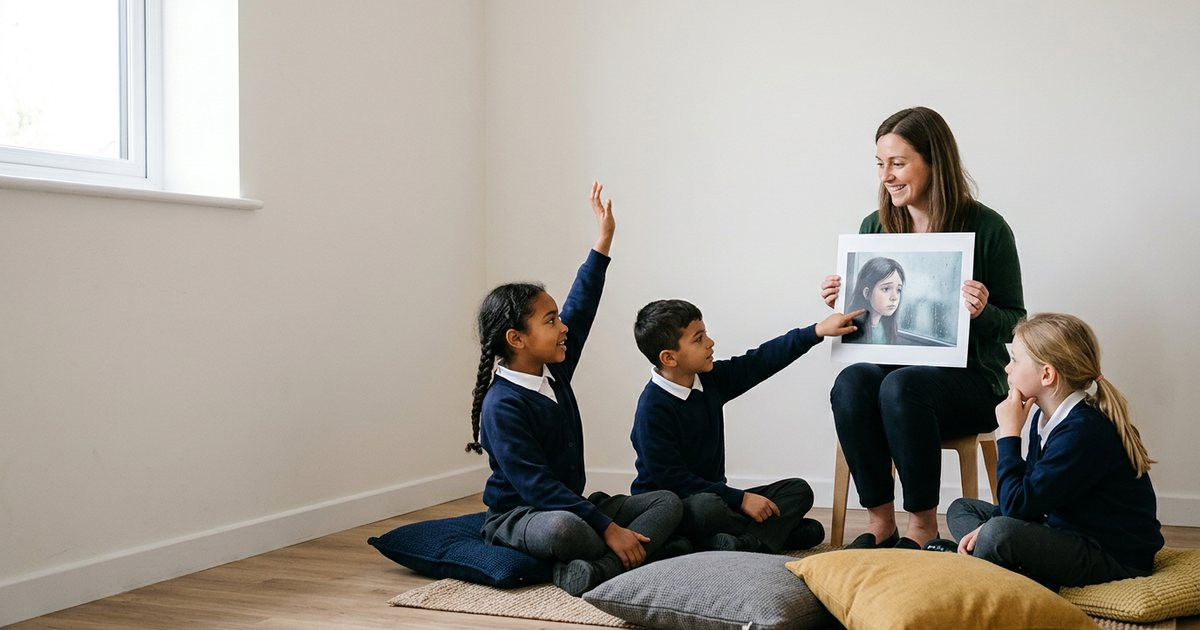
Use pictures first. Wordless picture books, adverts and photographs are a great way to practise inference without reading being a barrier. "What do you think has just happened here? What tells you that?"
Think aloud as you read. Share your own reasoning. "I think the grandfather is lonely, because he keeps saying how quiet the house is."
Watch with the sound off. In a short scene from a film or TV programme, ask what the characters are feeling from their faces and actions alone.
Explore feeling words. Children need precise vocabulary to express inferences: anxious, envious, relieved, reluctant. Talk about the difference between them.
Ask "what might happen because of this?" Predictions based on clues are a close cousin of inference.
In Years 3 and 4, focus on characters' feelings and simple motives, with one piece of evidence. In Years 5 and 6, push for more: two pieces of evidence, an explanation of how the writer creates an impression, and inferences about themes or a character's changing feelings across a whole chapter.
If your child reads accurately but regularly misses what a text implies, or always gives answers without evidence, structured practice can help. Our KS2 English tuition works on inference, explanation and evidence through discussion and guided reading. A free assessment can show whether inference is the main gap.
Inference is working out what is happening or what a character thinks now, from clues. Prediction uses clues to suggest what will happen next. Both depend on evidence in the text.
It can be taught. Children improve through regular discussion, wide reading that builds background knowledge, and practice explaining their answers with evidence.
Recent Posts
Categories
Tags