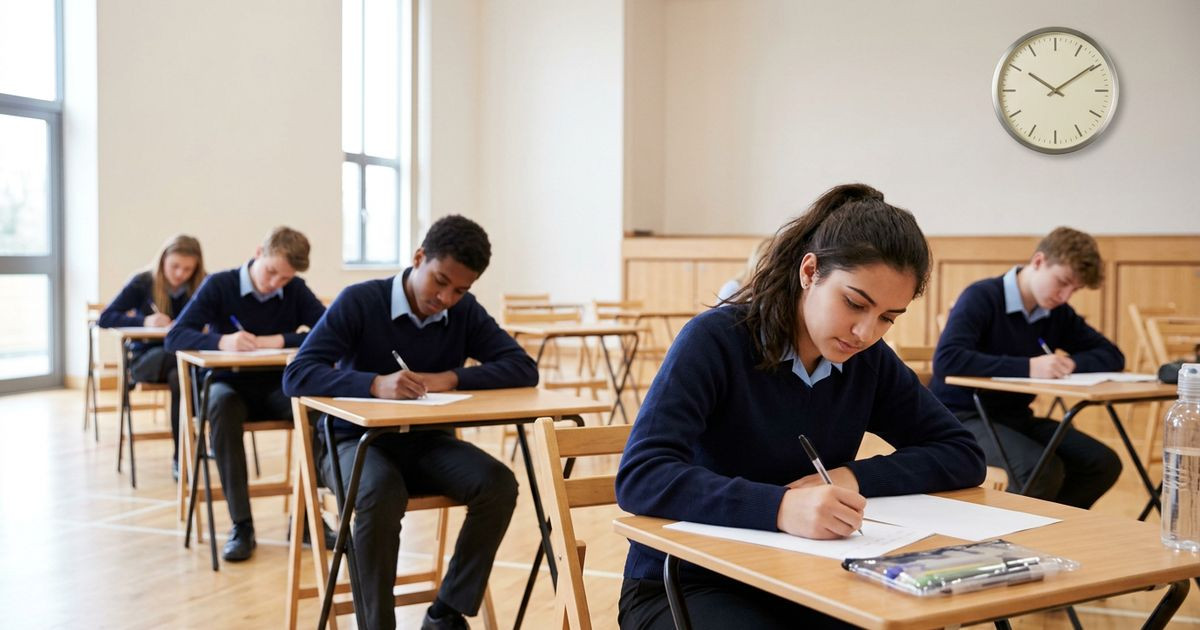
"Is my child going to be traumatised by SATs?" is one of the most common fears parents bring into Year 6, and most SATs advice online answers it by assuming the premise is true and jumping straight to coping tips. It is worth pausing on the premise first, because the actual UK research on this question is more reassuring, and more specific, than the conventional wisdom suggests.
A study led by Professor John Jerrim at UCL, using data from the Millennium Cohort Study tracking around 2,500 children, compared wellbeing in England, where Key Stage 2 SATs happen, against Northern Ireland, Scotland, and Wales, where they do not. The finding was direct: happiness and wellbeing levels among children in England and the rest of the UK "were very similar to one another and often overlapped." Around 24 percent of English children reported feeling unhappy about schoolwork before tests, compared with 28 percent in the rest of the UK, a gap the researchers found was not statistically significant. The study also found no meaningful dip in wellbeing specifically around SATs week, and children were not noticeably happier once testing had finished.
Professor Jerrim described this as "an important counter to conventional narratives" about SATs causing widespread harm, and concluded the evidence was not strong enough to justify removing the tests on wellbeing grounds alone.
Population-level findings like this describe an average, not every individual child, and it would be dishonest to read this as "no child ever finds SATs stressful." Some children clearly do experience genuine anxiety around them, and that anxiety is real and worth taking seriously regardless of what the national picture shows. What the research does usefully rule out is the assumption that SATs are inherently and universally traumatic for the typical Year 6 child, which is a more accurate, and less alarming, starting point for most families.
For children who do feel anxious, there is a specific, well-evidenced intervention worth knowing about, and it takes ten minutes. Psychologists Ramirez and Beilock found that students who spent ten minutes writing about their worries and feelings immediately before a high-stakes test performed measurably better than those who did not, with the biggest benefit concentrated exactly where you would want it: among the students who were most prone to test anxiety in the first place. In their study, highly anxious students who wrote beforehand averaged close to a full grade higher than equally anxious students who did not, while a comparison group's accuracy actually fell under pressure without the writing exercise.
The mechanism is thought to be simple: unaddressed worry competes for the same mental resources a child needs to focus on the test itself, and briefly writing the worry down frees up that capacity rather than suppressing the feeling. Practically, this means giving an anxious child ten quiet minutes on the morning of a SATs paper to write down what they are worried about, with no pressure on what they write or who reads it, is a genuinely evidence-backed thing to try, not just a comforting ritual.
If anxiety around SATs is persistent rather than occasional, it is worth looking beyond generic tips. The government's "Coping with exam pressure" guidance, developed with Professor Dave Putwain of Liverpool John Moores University, is aimed primarily at GCSE, A-level, and vocational students rather than Year 6 specifically, but the NHS and Mind both offer more general resources for parents supporting a child through any exam-related anxiety, regardless of age. If the anxiety is affecting your child's daily life well beyond the test itself, our guide to recognising when school stress needs more support covers the warning signs worth watching for and when to involve the school or a GP.
For SATs-specific content, such as how the papers are actually marked and what the scaled score system means, our separate guide to Top KS2 SATs tips covers the exam format itself in detail.
Do SATs actually harm children's mental health?
UK research comparing children in England, who sit SATs, with children elsewhere in the UK, who do not, found no statistically significant difference in wellbeing, and no meaningful dip around test week specifically. This does not mean no child ever feels anxious about them, but it challenges the idea that SATs are universally harmful.
What is the single most evidence-backed thing I can do if my child is anxious about SATs?
Ten minutes of expressive writing about their worries immediately before the test has been shown in controlled research to measurably improve performance specifically for anxious students, by freeing up mental capacity that worry would otherwise use up.
Should I be worried if my child seems completely unbothered by SATs?
Not necessarily. The research suggests most children's wellbeing is not meaningfully affected by SATs at a population level, so a child who seems calm about them is consistent with the evidence, not a sign that something is being suppressed.
At what point should SATs-related worry be treated as a bigger concern?
If anxiety is persistent, affecting sleep, appetite, or daily functioning well beyond the test itself, rather than occasional nerves, it is worth speaking to the school or a GP rather than assuming it will pass on its own.
Sources:
Recent Posts
Categories
Tags



 Updated 18-September-2026