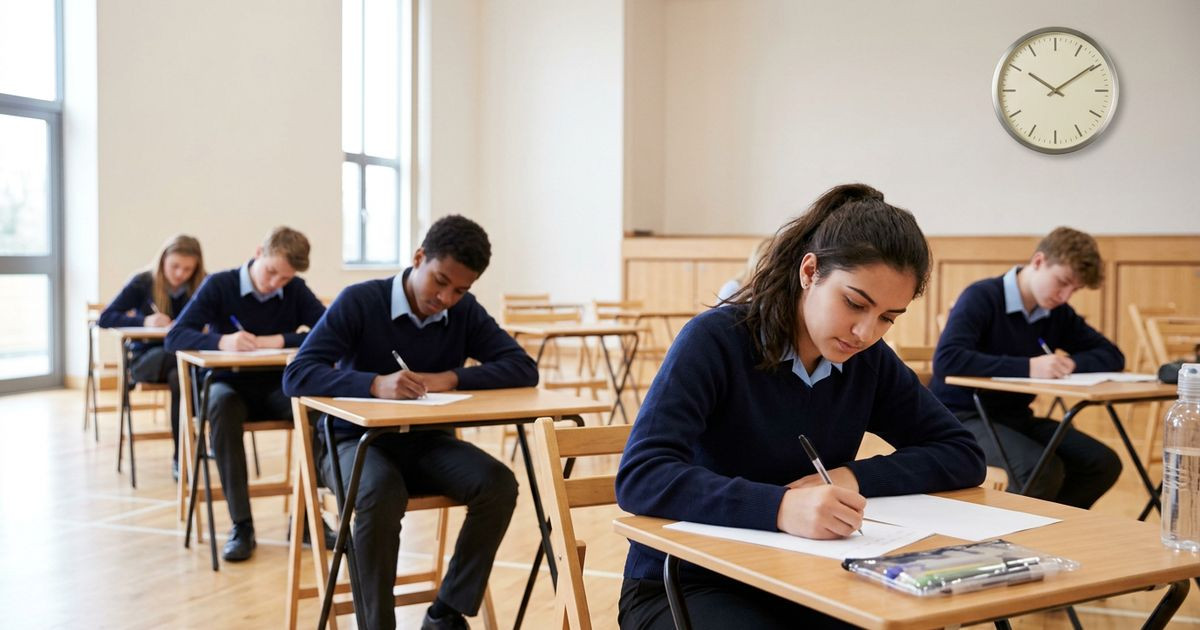
The EBacc has been scrapped as a measure of school performance in England, starting with the 2025 to 2026 GCSE results. No GCSE subject is disappearing. What goes is the pressure on schools to push most pupils into the same combination of a language plus history or geography, which in many schools left little room for art, music, drama or design and technology.
For a family choosing options in Year 9, that could mean more freedom. How much depends on what your child's school decides to do with it.
Many parents assume the EBacc is a qualification. It never was, and no pupil ever received an EBacc certificate. It was a way of judging schools, introduced in 2010, by counting how many pupils took this set of GCSEs and how well they did in them:
|
Subject area |
GCSEs that counted |
|---|---|
|
English |
English language and English literature |
|
Maths |
Maths |
|
Sciences |
Combined science, or two of biology, chemistry, physics and computer science |
|
Humanities |
History or geography |
|
Languages |
A modern or ancient language |
Because schools were measured on it, many built their options blocks around it. A pupil who wanted to take both art and music, for example, might find one of them squeezed out by the requirement to choose a language and a humanity.
The Curriculum and Assessment Review, published in November 2025, concluded that the EBacc had narrowed pupils' choices more than was justified. The government agreed, removed the EBacc headline measures from performance tables, and said arts GCSEs should carry equal weight with humanities and languages.
Progress 8, the main measure of how much progress pupils make at secondary school, stays. It is based on each pupil's results in eight subjects, slotted into groups. Under the current rules, three of those slots are reserved for EBacc subjects.
The government's proposed replacement keeps English and maths double-weighted and gives science two slots of its own. It also introduces two "breadth" slots that must come from two different categories: humanities (history, geography or religious studies), creative subjects (such as art and design, music, drama, and design and technology) or languages. Two further slots stay open to any other eligible GCSE or approved technical award.
The Department for Education consulted on this between February and May 2026, and its explanatory document says the model is intended for pupils starting GCSE courses in September 2027. The final shape depends on the consultation outcome. The Progress 8 explainer is published on GOV.UK alongside the government's response to the review.
Take a pupil who loves art and music and is reasonably good at history. Under the EBacc, a school might have encouraged them to drop one of the creative subjects for a language. Under the proposed Progress 8 model, art and history can fill the two breadth slots from different categories, and music can sit in an open slot. The school is no longer marked down for that combination.
That does not make history, geography or languages less worthwhile. They build extended writing, analysis and cultural understanding, and some universities and employers value a language at GCSE. The difference is that they can now be chosen because they suit the student, not because the school's figures depend on it.
Schools will still shape the menu. Options blocks, staffing and timetables vary, and some schools will widen their offer quickly while others change very little.
The core is fixed: English, maths and science are compulsory, and a grade 4 or above in English and maths remains the minimum for most sixth forms, colleges and many jobs. Beyond that, it helps to look two steps ahead. If your child is drawn to a particular A Level or career, check which GCSEs support it.
A balanced set, with an essay subject, a practical or creative subject and a language or humanity, keeps most doors open. Interest matters too. Students tend to work harder at subjects they enjoy, and that usually shows in their grades. Finally, ask the school how its options blocks work and which combinations are possible, as the answer varies more than many parents expect.
Options are easier to choose when the core subjects feel secure. Our KS3 tuition works on English, maths and science before Year 9 decisions, and GCSE tuition supports students once their courses begin.
Not because of the EBacc. The proposed Progress 8 model encourages schools to offer breadth, but it measures schools. It does not set rules for individual pupils.
No. Universities set requirements based on individual GCSE subjects and grades, and the EBacc was never part of them.
Recent Posts
Categories
Tags




 Updated 19-October-2026