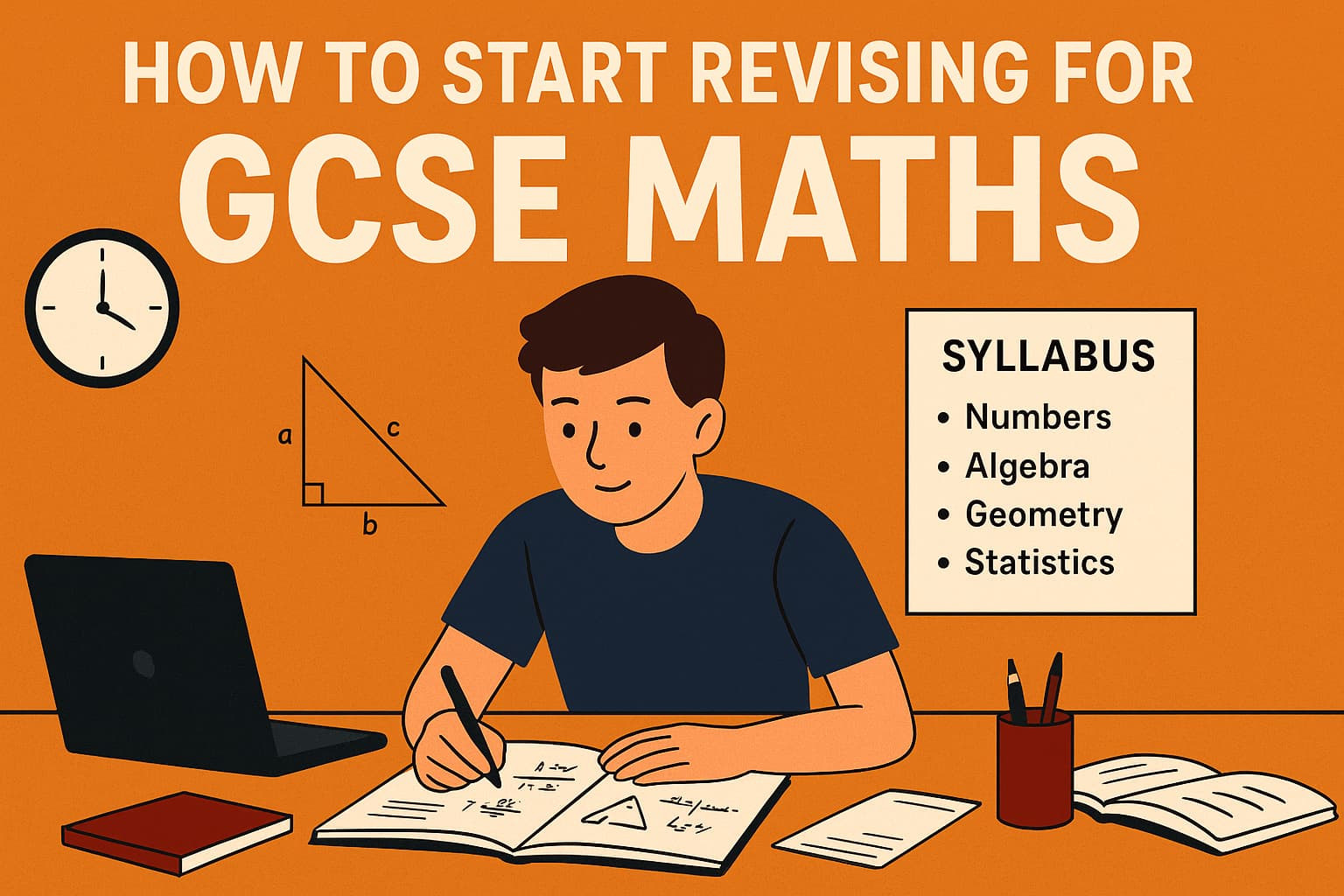
Most GCSE Maths revision advice starts with a study schedule. It should really start with two questions that shape everything else: which tier is your child sitting, and which topics is the revision time actually going to. Here's a practical way to begin, built around the exam structure itself rather than generic study tips.
GCSE Maths is split into Foundation tier, which covers grades 1 to 5, and Higher tier, which covers grades 4 to 9 (with grade 3 available as a safety net), according to Pearson Edexcel's GCSE Mathematics specification. This matters for revision planning in a very direct way: a student secure on Higher tier content is revising to push from a 6 or 7 toward an 8 or 9, which means time on the hardest algebra and geometry proof questions. A student closer to the Foundation and Higher tier boundary is better served consolidating the topics both tiers share, rather than attempting Higher-only content that won't appear on their paper at all. If the tier decision hasn't been made yet, that conversation with the school needs to happen before a revision plan does.
GCSE Maths is assessed across three papers, one non-calculator and two calculator, each 1 hour 30 minutes and worth 80 marks, so each paper carries an equal one-third of the total grade. Every paper covers all six content areas (Number, Algebra, Ratio, Proportion and Rates of Change, Geometry and Measures, Probability, and Statistics), so no single paper specialises in one topic. Two things follow from this. First, non-calculator arithmetic and manipulation need to be genuinely fluent, not just "possible with a calculator," since a third of the marks depend on it. Second, because every topic can appear on every paper, revision has to cover the full spread of content rather than assuming a topic is "covered" once it's been revised for one paper. This breakdown reflects Pearson Edexcel's specification specifically; confirm the exact paper count, timing and mark total against your child's own exam board, since a different board's numbers should be checked directly rather than assumed to match.
Not all revision advice is equally well supported. The Education Endowment Foundation's research on metacognition and self-regulated learning (drawn from 355 studies, rated high security) found that pupils taught to explicitly plan, monitor and evaluate their own learning made an average of eight months' additional progress compared with those who weren't. In practice, for GCSE Maths revision, that looks like:
Plan around a diagnostic, not a syllabus list. Start with a full past paper under timed conditions to see which of the six content areas are genuinely weak, rather than revising every topic equally.
Monitor with past paper marks, not a feeling of readiness. Mark strictly against the official mark scheme and track marks by topic over successive papers, so progress is measured rather than assumed.
Evaluate and adjust the plan every one to two weeks. If a topic still isn't improving after focused revision, that's a signal to get direct help rather than keep repeating the same self-study approach.
This is a more effective use of time than working sequentially through a revision guide from cover to cover, since it puts the most time where the marks are actually being lost.
Sit one full past paper from the correct tier and exam board under timed conditions, mark it properly against the mark scheme, and use the topic breakdown to decide where the next two weeks of revision actually go. That single diagnostic step does more to focus a revision plan than any generic checklist.
Merit Tutors' GCSE Maths revision courses start with exactly this kind of diagnostic assessment, with small groups working on the specific topics a student's past papers show as weak, rather than a fixed curriculum everyone follows regardless of starting point. The wider GCSE tuition programme covers Maths alongside English and the sciences, and for students continuing Maths into sixth form, the A-level Maths revision courses build on the same foundations. A free assessment is a good starting point if you're not sure which tier or topics need the most attention.
What if my child doesn't know their tier yet?
Ask the school directly before building a revision plan. Foundation and Higher tier papers test different content past the shared middle ground, so time spent on the wrong tier's material does not transfer to the exam actually sat.
Does my child need to revise every topic equally?
No. Since all six content areas (Number, Algebra, Ratio, Proportion and Rates of Change, Geometry and Measures, Probability, and Statistics) can appear on any of the three papers, a diagnostic past paper is a better starting point than an even split, so revision time goes where a student's own marks show weakness.
How many past papers should my child complete before the exam?
There's no single correct number; what matters more is the cycle behind it, sitting a paper, marking it properly against the mark scheme, and adjusting the next block of revision based on where marks were actually lost, repeated every one to two weeks rather than done once close to the exam.
Is revising from a textbook or revision guide cover to cover a good use of time?
Generally not the most efficient approach. Working sequentially through a guide spends equal time on strong and weak topics alike, whereas diagnostic-led revision, starting from a past paper's results, directs the most time to where it is actually needed.
Recent Posts
Categories
Tags



 Updated 17-September-2026