Updated 19-May-2026
GCSE Maths is one of the subjects that can cause the most stress for students and parents. It is also one of the most important qualifications for college courses, apprenticeships, university pathways and future employment. Whether a student is aiming to secure a grade 4 on Foundation tier or push towards grades 7 to 9 on Higher tier, the right revision support can make a real difference.
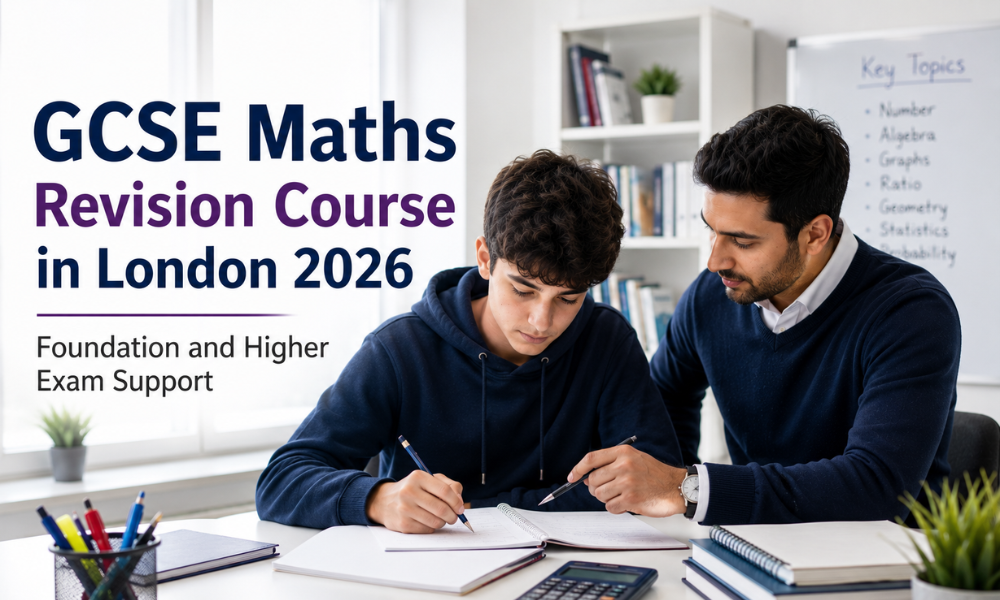
A GCSE Maths revision course in London can help students organise their revision, practise exam-style questions and build confidence before mocks or final exams. At Merit Tutors, we support students through structured GCSE tuition and targeted revision courses designed to improve understanding, accuracy and exam technique.
This guide explains what a good GCSE Maths revision course should include, how Foundation and Higher students should prepare differently, and how parents can choose the right support.
Many students revise Maths by doing random questions or watching videos without a clear plan. This can help a little, but it often leaves gaps. Maths topics are connected, so weak foundations can affect several areas at once. A student who struggles with fractions may also struggle with ratio, percentages, probability and algebraic manipulation.
Structured revision helps students work through topics in a logical order. It also gives them enough practice to move from "I understand this when someone explains it" to "I can answer this correctly in an exam".
A good GCSE Maths revision course should not only reteach content. It should help students identify weak areas, practise under exam conditions, correct mistakes and learn how to approach unfamiliar questions.
GCSE Maths students usually sit either Foundation or Higher tier. Choosing the right revision approach depends on the student's current level and target grade.
Foundation tier is designed for students working towards grades 1 to 5. Revision should focus on secure methods, accuracy and confidence with core topics. Students need strong skills in number, fractions, percentages, ratio, algebra basics, graphs, angles, probability, averages and problem-solving. For many Foundation students, improving careless errors and reading questions carefully can make a big difference.
Higher tier is designed for students aiming for grades 4 to 9. Higher students still need strong basics, but they also need to practise more advanced topics such as quadratic equations, simultaneous equations, surds, bounds, circle theorems, trigonometry, vectors, histograms and complex multi-step problems.
The best GCSE Maths tuition recognises this difference. Foundation students should not be rushed into overly difficult questions before core skills are secure. Higher students should not only revise easy topics and avoid the harder questions that carry higher-grade marks.
A strong GCSE Maths revision course should cover the main topic areas tested by exam boards such as AQA, Pearson Edexcel and OCR. At Merit Tutors, our GCSE Maths revision course includes key areas such as Number, Algebra, Graphs, Ratio and Proportion, Geometry and Measures, Statistics and Probability.
Number topics may include fractions, decimals, percentages, rounding, estimation, powers, roots and surds. Algebra may include expanding brackets, factorising, solving equations, rearranging formulae, inequalities, sequences and quadratic expressions. Geometry may include angles, transformations, area, perimeter, volume, Pythagoras, trigonometry and vectors.
Students also need regular practice with exam-style problem-solving. In GCSE Maths, marks are often lost because students do not know which method to choose. A good revision course should train students to read questions carefully, identify the topic being tested and show working clearly.
Past papers are one of the most useful parts of GCSE Maths revision because they show students how topics appear in real exams. They also help students practise timing and learn how marks are awarded.
However, past papers only work if students review them properly. Completing a paper and ignoring the mistakes is a wasted opportunity. Students should mark their work carefully, identify the topics they lost marks on and then practise those areas again.
Official exam board resources can help students become familiar with real question styles. Useful sources include AQA past papers and mark schemes, Pearson Edexcel past papers and the OCR past paper finder.
Mock tests are also valuable because they recreate exam pressure. They help students learn how to manage time, decide when to move on from a difficult question and avoid losing easy marks through rushing.
Some students understand topics in class but struggle when questions are mixed together. Others know the method but lose marks because of careless arithmetic, missing working or poor layout. Some students panic when they see worded problems because they are not sure what the question is asking.
These problems are common, and they can improve with the right support. A tutor can help students slow down, organise their working and build a repeatable method for approaching questions.
Confidence is also important. Students who believe they are "bad at Maths" often avoid practice, which makes the problem worse. A structured revision course can rebuild confidence by showing students that progress is possible one topic at a time.
Parents do not need to be Maths experts to support revision. The most useful thing parents can do is help create consistency. Short, regular revision sessions are usually better than occasional long sessions.
Encourage your child to keep a mistake list. After each worksheet, mock test or past paper, they should write down the topics they lost marks on. This list becomes a personalised revision plan.
Parents can also ask simple questions: Have you marked the paper? Which topics were difficult? Did you redo the questions you got wrong? What will you practise next?
If your child is still unsure where to begin, a free assessment can help identify their current level and the areas that need attention.
Merit Tutors provides GCSE tuition for students who need support with Maths, English and Science. Our GCSE Maths booster course is designed to help students strengthen key topics, improve exam technique and build confidence before exams.
Lessons are structured around the needs of the learner, with small group support, regular homework, mock tests, written feedback and progress tracking. Students are supported with content relevant to major exam boards, including Edexcel, AQA and OCR.
Our East London centres support families from Forest Gate, Ilford, Plaistow and nearby areas, with online options also available where suitable.
If your child needs GCSE Maths support, the best first step is to understand their current level. An assessment can show whether they need Foundation confidence-building, Higher tier challenge, topic repair or exam technique support.
Contact Merit Tutors to book a free assessment or ask about GCSE Maths revision course availability.
A GCSE Maths revision course is a structured programme that helps students review key topics, practise exam-style questions, improve technique and prepare for mocks or final exams.
Yes. Foundation students usually focus on core accuracy and confidence, while Higher students need more advanced problem-solving and higher-grade topics.
Yes. Merit Tutors teaches content relevant to major exam boards, including AQA, Pearson Edexcel and OCR.
Yes. Past papers help students practise timing, exam wording and mark schemes. They are most useful when students review mistakes and practise weak topics afterwards.
Yes. GCSE Maths revision support can help students rebuild confidence by breaking topics down, practising regularly and tracking progress.
Recent Posts
Categories
Tags