Money is taught in primary maths from Year 1. It starts with recognising coins and notes and builds up to adding amounts, giving change and solving word problems with pounds and pence. Children often find it harder than parents expect. Fewer families use cash today, so many children rarely handle coins or see change being counted.
The good news is that money is one of the easiest maths topics to practise in everyday life, as long as some real coins are involved.
|
Year group |
What the national curriculum expects |
|---|---|
|
Year 1 |
Recognise and know the value of different coins and notes |
|
Year 2 |
Use the £ and p symbols; combine coins to make a set amount; find different combinations of coins for the same value; add and subtract money and give change |
|
Year 3 |
Add and subtract amounts of money to give change, using both £ and p in practical contexts |
|
Year 4 |
Estimate, compare and calculate with money in pounds and pence; solve problems with money to two decimal places |
|
Year 5 |
Use all four operations to solve problems involving money and other measures |
|
Year 6 |
Apply money skills in multi-step problems, including percentages and decimals |
The first five rows are taken from the national curriculum for mathematics on GOV.UK. In Year 6, money appears through wider problem solving rather than as a separate topic.
Money is also becoming more important beyond maths lessons. Under the new national curriculum due from September 2028, financial literacy will be taught as part of statutory citizenship in primary schools.
Children need to know that a coin's value does not depend on its size. A 5p coin is smaller than a 2p coin but worth more. Sort a pile of real coins together and talk about each one.
In Year 2, children combine coins to make a total. Start small:
"Can you make 10p using two coins?"
"Find three different ways to make 20p."
"What is the fewest number of coins you can use to make 50p?"
Questions with more than one answer build flexible thinking, not just recall.
Change is easiest when children count up from the price, the way shop staff traditionally do. If something costs 35p and you pay with 50p, count on: 35p, 40p, 50p. The change is 15p.
In Key Stage 2, children write amounts such as £3.45. They need to understand that the digits after the decimal point are pence, and that £3.05 and £3.50 are different amounts.
Children should know that £1 equals 100p. Practise converting both ways, such as 250p = £2.50 and £4.07 = 407p.
Money problems often involve more than one step. For example: "Sam buys a book for £4.75 and a pen for £1.30. He pays with a £10 note. How much change does he get?" Encourage your child to underline the key information and write down each step.
|
Mistake |
Example |
What helps |
|---|---|---|
|
Judging value by size |
Thinking 2p is worth more than 5p |
Sorting and ordering real coins |
|
Mixing £ and p |
Writing £150p |
Practise writing amounts one way, then converting |
|
Decimal confusion |
Reading £3.05 as three pounds fifty |
Use place value: pounds, tenths and hundredths |
|
Losing track of change |
Subtracting in the wrong order |
Count up from the price to the amount paid |
|
Missing a step in word problems |
Finding the total but not the change |
Underline what the question asks for |
Children learn money best by handling it.
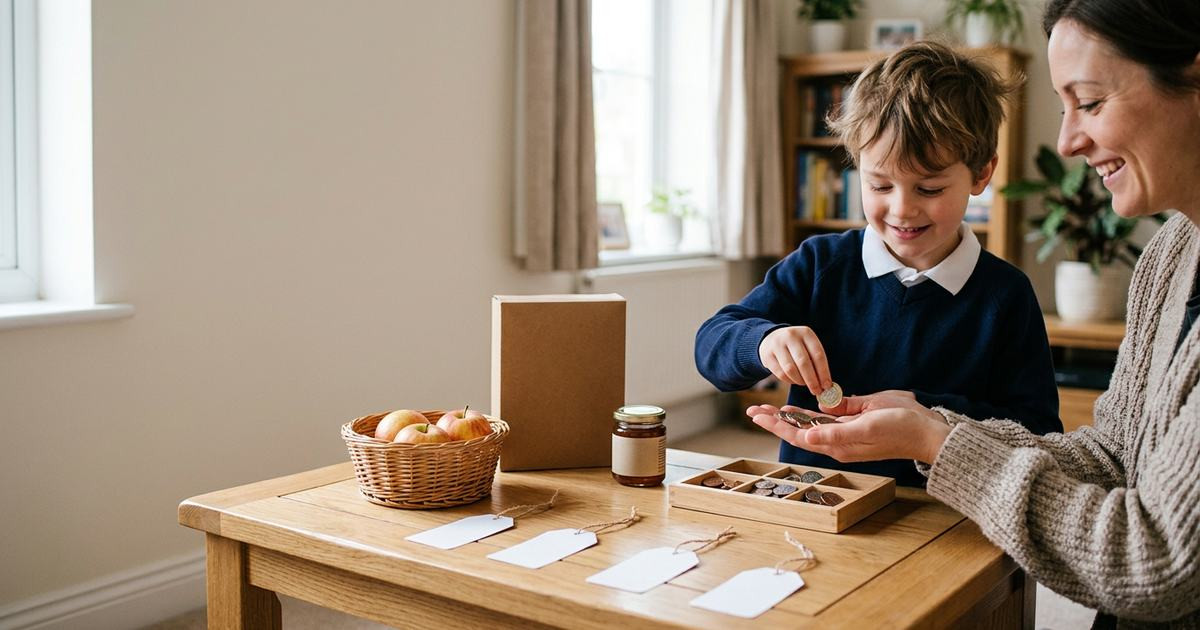
Play shop at home with real coins and price labels.
Let your child pay at a till using cash, and count the change together.
Compare prices in a supermarket: "Which is cheaper per item?"
Give a small budget for a treat or snack, and let your child plan how to spend it.
Use a savings jar and count it regularly.
Talk about card payments. Explain that money still leaves an account when you tap a card or phone.
A child who struggles with money often has a gap in place value, addition or decimals underneath. Our KS1 maths tuition and KS2 maths tuition look for those gaps first, and our Year 3 maths workbooks offer extra number practice at home.
Money in primary maths progresses from recognising coins in Year 1 to multi-step problems with pounds and pence in Years 5 and 6. The biggest challenges are judging value, using decimals correctly and calculating change. Handling real coins, playing shop and talking about prices during everyday life give children the practice that textbook questions alone cannot.
Recent Posts
Categories
Tags



 Updated 09-November-2026