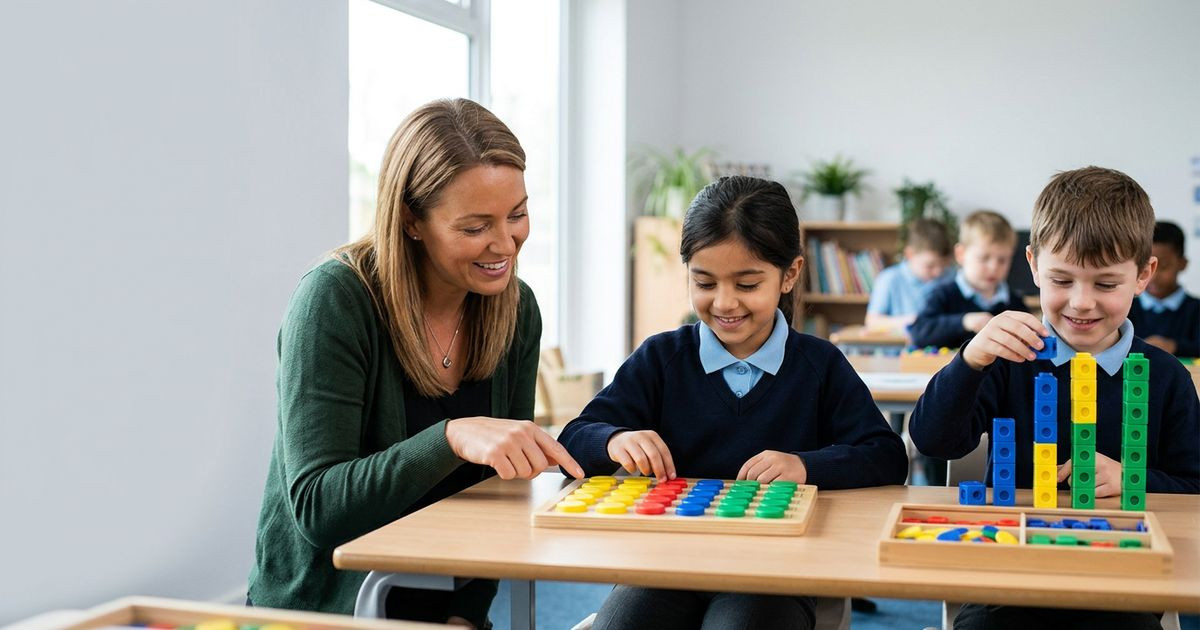
Your child looks at the word "cat" and says "c... a... t" perfectly. Then they pause, and say "cup". Or "tac". Or nothing at all. If that sounds familiar, you are watching one of the most common hurdles in early reading. Knowing the sounds is one skill. Pushing them together into a word, called blending, is another, and for many children it takes weeks of short, regular practice before it clicks.
The good news is that blending can be taught, and parents can help a great deal with a few minutes a day.
In phonics, children learn that letters, or groups of letters, represent sounds. The word "ship" has three sounds: "sh", "i", "p". Blending means saying those sounds in order and merging them so that you hear the word. Segmenting is the reverse: hearing a word and breaking it into its sounds, which children need for spelling.
Blending is harder than it looks because children have to do three things at once. They must recognise each letter or letter group, remember the sound it makes, and hold all of those sounds in mind while joining them. For a four or five year old, that is a real strain on memory. It is also why longer words, and words with letter pairs like "sh" or "ee", feel much harder at first.
Adding an "uh" to sounds. If "m" becomes "muh" and "t" becomes "tuh", the word "mat" turns into "muh-a-tuh", which does not sound like "mat" at all. Pure sounds, said crisply without the extra "uh", make blending far easier. Your child's school will be using a phonics programme with its own pronunciation, so ask the teacher or look at the programme's guide for parents.
Too much of a gap between sounds. A long pause between "c", "a" and "t" means the first sound has faded before the last arrives.
Not knowing the sounds automatically. If your child has to think hard about each letter, there is little attention left for blending. Quick, confident sound recognition comes first.
Words that are too long too soon. Two- and three-sound words are the place to start.
Start with spoken words and no print at all. Say "Can you touch your h-a-t?" or "Where is your l-e-g?" and see if your child can work out the word. Games like this build the listening skill on its own, without the extra load of reading letters.
Choose words made only of sounds your child has already learned at school, such as "s", "a", "t", "p", "i" and "n". Words like "sat", "pin", "tap" and "nap" are ideal.
Point to each letter and say the sound together, then say them again more quickly, then once more, until the word appears. "S-a-t... s-a-t... sat!" Some children find it helps to stretch "continuous" sounds like "s", "m" and "f" so that they run into the next sound: "sssaaat".
Many schools draw a dot under each single-letter sound and a short line under letter pairs, then children touch each one as they say the sound and sweep a finger underneath to blend. Ask whether your child's school uses this, and copy it.
Once your child can blend simple words, they need plenty of practice reading real sentences. The books sent home from school should be decodable, meaning they are matched to the sounds your child has been taught. Re-reading the same book two or three times is useful, because each time more words are read quickly and the meaning becomes clearer.
Many schools still use the phase numbers from the older Letters and Sounds programme, or similar stages in their own scheme. Phase 2 introduces the first single-letter sounds and simple blending. Phase 3 adds the remaining letters and many letter pairs, such as "ch", "sh", "th", "ng", "ai", "ee", "igh" and "oa". This is often where blending feels hardest, because children must now spot that two letters make one sound. If your child reads "s-h-i-p" instead of "sh-i-p", that is the issue to practise.
Little and often works best. Five to ten minutes a day is plenty in Reception, and stopping while your child is still enjoying it matters more than finishing a page. The Department for Education's reading framework stresses the importance of children reading decodable texts matched to their phonics knowledge, and of re-reading to build fluency.
Some children take longer than others to blend, and that is normal in Reception. Talk to the class teacher if your child still cannot blend simple three-sound words by the end of Reception or early in Year 1, despite regular practice. The same applies if they struggle to hear rhymes or the first sound in a word. Schools can provide extra phonics sessions, and the Year 1 phonics screening check in June is designed to flag children who need more support.
For children who need extra practice beyond school, our KS1 English tuition works on phonics, blending and early reading at a pace that suits the child. If you are not sure whether your child needs it, a free assessment is a sensible first step.
Sounds come first for reading. Most phonics programmes teach letter names later, once children can use the sounds confidently.
Pictures help with meaning, but guessing can hide the fact that a child is not yet decoding. Gently cover the picture and ask them to sound out the word, then look at the picture together afterwards.
Recent Posts
Categories
Tags



 Updated 16-November-2026