Science in Year 1 and Year 2 is mostly about looking closely, asking questions and sorting things out, which makes it one of the easiest subjects to support at home. The activities below follow the topics in the national curriculum for Key Stage 1, and almost all of them use things you already have in the kitchen, the garden or the local park.
None of them need a "right answer". What matters at this age is that your child notices something, wonders about it, and has a go at finding out.
The national curriculum sets out these topics for five to seven year olds:
|
Year 1 |
Year 2 |
|---|---|
|
Plants |
Living things and their habitats |
|
Animals, including humans |
Plants |
|
Everyday materials |
Animals, including humans |
|
Seasonal changes |
Uses of everyday materials |
Alongside the topics, children learn to "work scientifically": asking simple questions, observing closely, doing simple tests, sorting things into groups, and recording what they find. You can see the full list in the national curriculum for science on GOV.UK.
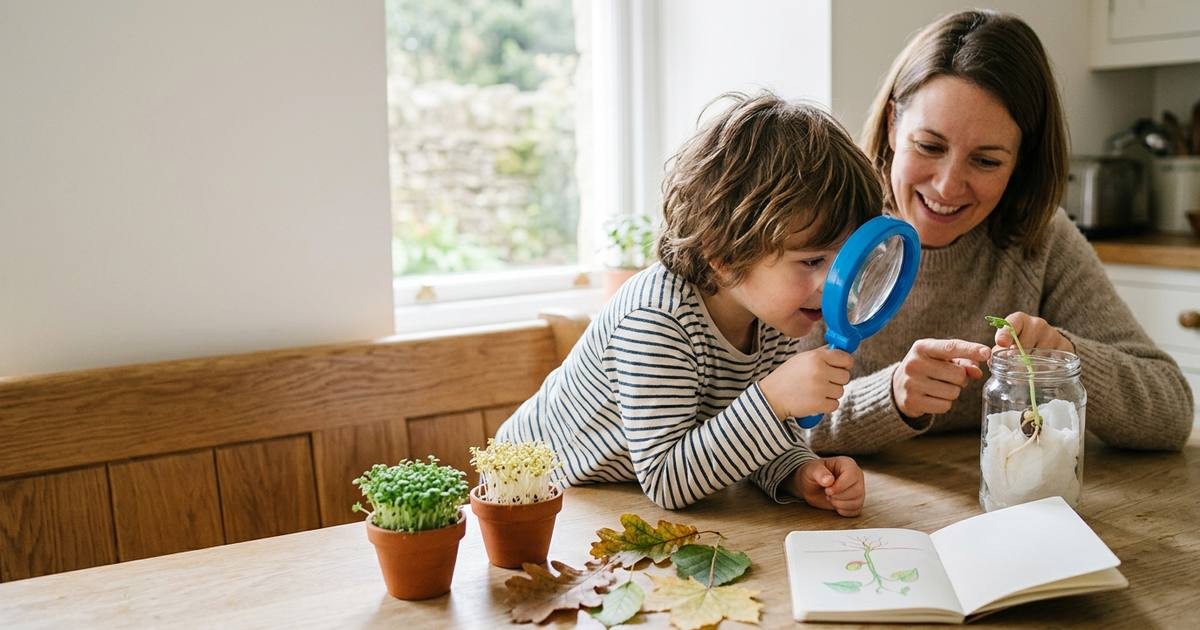
Grow a bean in a jar. Line a clear jar with damp kitchen roll and slide a dried bean or two between the paper and the glass. Keep it damp and look every day. Your child can watch the root appear first, then the shoot, and draw what they see each few days. This links directly to the Year 2 statement about seeds growing into mature plants.
What does a plant need? Grow two cress pots side by side. Put one in a dark cupboard and one on a sunny windowsill, and water both. After a week, compare them. Ask your child why they think the cupboard cress looks pale and spindly. Then try another pair, one watered and one not.
Leaf hunt. In autumn, collect leaves from different trees and sort them by shape, size or colour. Go back to the same trees in winter: which still have leaves? This introduces the Year 1 idea of deciduous and evergreen trees without any worksheets.
Minibeast safari. Lift a log or a large stone in the garden or park and see what lives underneath. Count the legs on what you find. Talk about why woodlice and worms like dark, damp places. Put everything back where you found it.
Senses walk. On a short walk, stop and ask what your child can hear, smell and feel. At home, try a blindfold taste test or a "mystery bag" of objects to identify by touch. Year 1 children learn which body part goes with each sense.
Carnivore, herbivore or omnivore? Sort pictures of animals, or toy animals, by what they eat. Your child will soon spot that some animals do not fit neatly, which is a good conversation in itself.
Material sort. Collect a spoon, a sock, a cup, a stone, a plastic toy and a glass jar. Ask your child to sort them by what they are made of, then by whether they are hard or soft, rough or smooth, shiny or dull. Year 1 is about telling the difference between an object and the material it is made from.
Waterproof test. Which material would make the best umbrella for a teddy? Drip water onto kitchen roll, foil, fabric and a plastic bag, and see which ones let water through. Ask your child to predict first, then check.
Squash, bend, twist, stretch. For Year 2, gather play dough, an elastic band, a sponge and a metal spoon. Which can you squash? Which spring back? This covers the Year 2 statement about materials changing shape.
Weather diary. For a week each season, record the weather with simple pictures. Add the time it gets dark. By the end of the year your child will have their own evidence that days are shorter in winter.
Dress for the weather. Lay out clothes for a sunny day, a rainy day and a cold day, and ask your child to choose what they would wear for each and why. It links the weather they record to the seasons they are learning about.
Alive, dead or never alive? Collect a leaf, a stone, a pine cone, a toy and a piece of fruit. Sort them into three groups. The pine cone and the fruit usually prompt the best discussion.
Build a simple food chain. After spotting a bird in the garden, ask what it eats, and what that animal eats. Draw the chain with arrows from food to eater. Year 2 children learn to describe simple food chains.
The difference between a fun activity and a science lesson is often just a few questions. Before you start, ask "What do you think will happen?" Afterwards, ask "What did you notice?" and "Was it what you expected?" Encourage your child to draw or record what they found, even with a few words and a picture. Over time, those habits matter more than any single experiment.
Keep safety simple: supervise anything involving water, small objects or sharp tools, wash hands after handling soil or minibeasts, and never let children taste anything from outside.
Much of KS1 science depends on reading, talking and counting. Children need the vocabulary to describe what they see, and the number skills to measure and compare. Our KS1 English tuition and KS1 maths tuition build those foundations, which help across every subject.
Recent Posts
Categories
Tags



 Updated 12-November-2026